

"EVERY OLIVE TREE IS PART OF THE FAMILY THAT CARES FOR IT."
February 11, 2026

Turkey is considered the homeland of the olive. It is believed that the cultivation of wild olives, transforming them into domesticated plants, began approximately 10,000 years ago near our border with Syria.
Olive and olive oil culture spread from Anatolia to Cyprus, Crete, and later to the Western Mediterranean countries. This spread accelerated exponentially, especially in ancient times. The Klazomenai olive oil workshop in Urla, dating back to the 6th century BC, is a very good indicator of how advanced the region's technology was compared to the rest of the world at that time. This technology, still in use today, is called stone pressing . In stone pressing, olives, which are turned into a paste by stone mills, are filled into burlap sacks. Pressure is applied to them, and hot water is poured to increase their fluidity. The oil seeps through the holes in the pressed sacks, and this is where the name Extra Virgin Olive Oil comes from. No matter how much care is taken, it is inevitable that the oil loses its wonderful aroma and health-giving antioxidants in stone pressing, meaning the quality of the oil decreases.
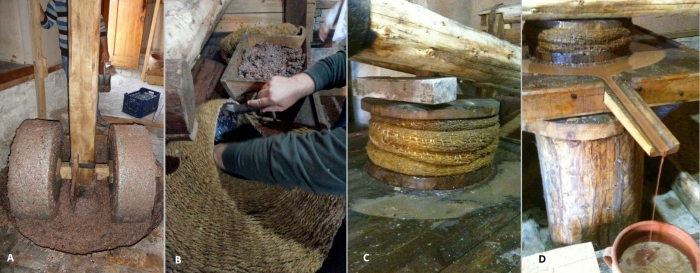
Olive 2013, Klazomenai (6th century BC reconstruction) Olive Workshop, Urla. We thank Dr. Cahit Tunç for his guidance, and Prof. Dr. Yaşar Ersoy and Ali Ertan İplikçi for their hospitality. A) Crushing the olives in a stone mill B) Filling the olive paste into burlap sacks C) Pressing the olives D) The resulting water-oil mixture
In the last century, " Continuous Olive Oil Factories ," which use centrifuges instead of presses to separate olives from oil, have become widespread throughout the world. The word "continuous" comes from "continuous," meaning without pause. Olives enter the machine from one end and emerge as olive oil from the other. Provided it is operated cleanly and carefully, this new technology produces extra virgin olive oil of the highest quality with high yield. If the prerequisites of cleanliness and care are not met, defects occur. These oils, whose quality has decreased, are classified as virgin . Many of us, unaware of the difference in quality, prefer such poorly treated olive oils because their taste is similar to the stone-pressed olive oil we know from our ancestors.
Of course, the " New World " countries, which are newly introduced to olives, also want to have a share in this rapidly growing market. Giant olive sapling companies are conducting R&D studies to create new, high-yielding varieties that can survive outside the Mediterranean and even withstand extreme climatic conditions such as the Arabian deserts or the Nepalese mountains. Olive oil production has increased from 1,000 to 15,000 tons in the USA and from zero to 20,000 tons in Australia in the last 20 years. In the New World, the classic, handcrafted olive groves we are accustomed to are rarely seen anymore. New businesses are transforming into giant olive farms where millions of trees can be mechanically pruned and harvested in a few hours, not days or weeks. Millions of liters of extra virgin olive oil are produced with the most advanced technology, stored in dry, cool, and oxygen-free special tanks, and marketed most effectively all over the world in specially designed bottles or packaging.
We live in a land with the oldest and richest olive genetic diversity and olive oil culture. Of the world's 900 million olive trees, 169 million are in Türkiye. We are the world's fourth largest olive oil producer (155,000 tons this year), after Spain, Italy, and Greece. However, it seems we are unaware of this value. Our per capita consumption is not even a quarter of that in these countries. We are not developing technology suitable for our own conditions. While the world seeks extra virgin olive oil for health reasons, we don't like its taste. Because we don't do this consciously, we don't question our habits, and we can't articulate why we prefer certain things. As a result, despite our thousands of years of experience as a country, we are lagging behind the rapidly advancing world.
Of course, there are those who work to the highest standards, but their numbers are small, and their economic resilience depends on personal sacrifice. Naturally, nobody gives up because that's the custom in our old, Mediterranean world: olive farming continues even if it doesn't bring in profit.
Ultimately, every olive tree is part of the family that cares for it.
Zeynep Delen Nircan
Founder of Workshop in the Aegean
https://sarkac.org/2018/03/zeytinyaginda-boynuz-kulagi-geciyor/
